Home Blog

Written By Jenny Doe
Reviewed By Jenny Doe
9 Min Read
Home Blog
9 Min Read

Heena Goyal

17 Nov 2026

Min

11
When was the last time you searched for something on Google? Maybe you wanted to understand a business concept, compare two products, or find a solution to a problem. Before, you’d usually get a list of websites to pick what’s worth opening. Now, depending on what you search for, Google may provide an AI-generated summary before you reach the traditional organic results.
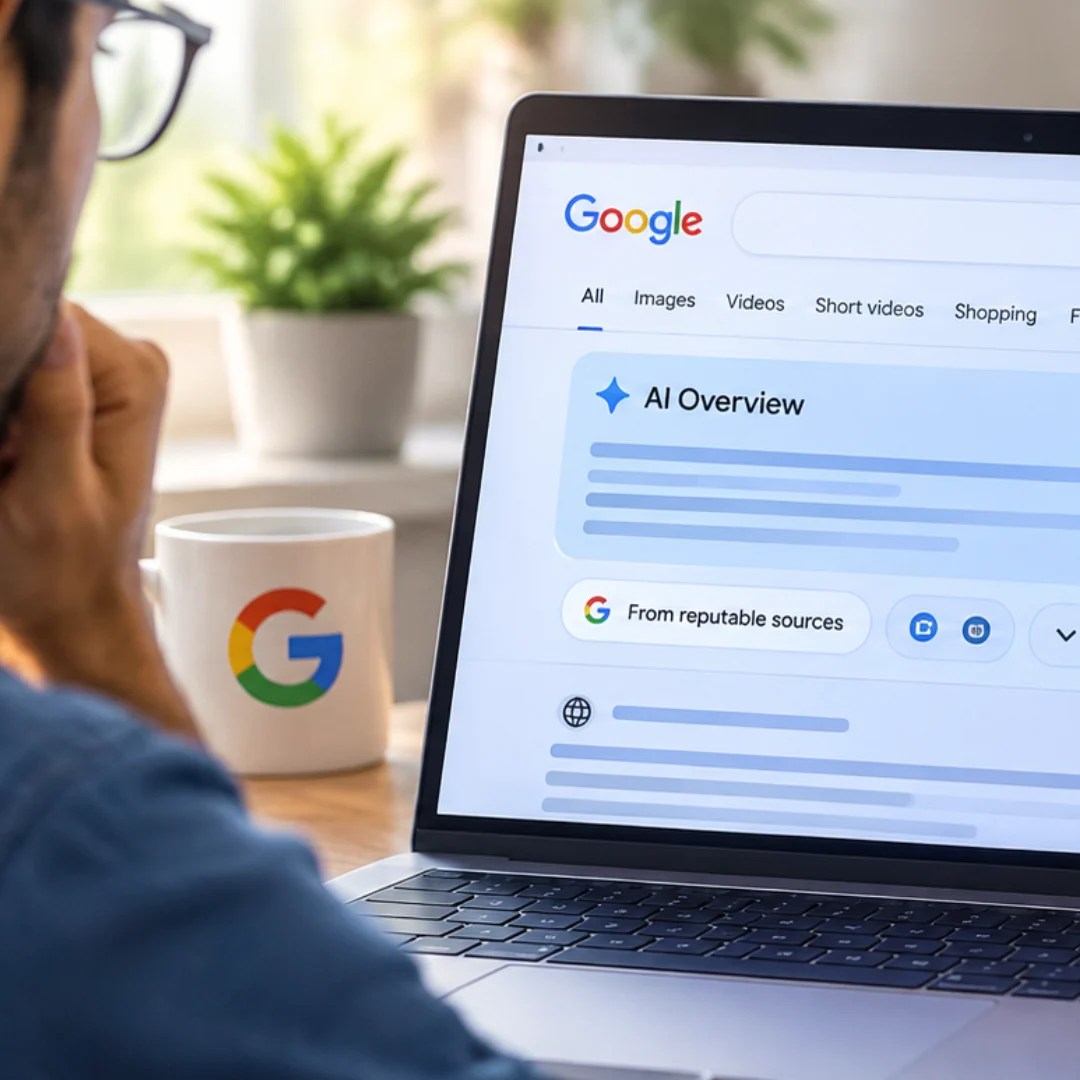
This is where Google AI Overviews enter the picture, and things start getting interesting for anyone who relies on organic search. Until recently, finding information on Google usually meant opening a few websites, scanning through their content, and piecing together the answers. AI Overviews have changed the way people find information on Google. Someone looking for a quick answer may now get what they need right on the search results page, without having to visit two or three websites. The links are still there for those who want to read further, but not everyone will feel the need to click through.
For website owners and SEO professionals, this brings a different challenge. Getting a page to rank is one thing, but getting people to visit it is becoming a different ball game.
It affects the way websites get noticed and, more importantly, whether that visibility turns into a visit. A page may continue to hold its position in organic search, yet the journey from appearing on Google to earning a click is no longer quite the same.
Does this mean traditional SEO is on its way out? Far from it. But the goalposts are shifting, and businesses need to understand what that means for their search visibility.
Google AI Overviews are changing the way Google serves up information. For certain searches, Google now pulls together relevant information from different websites and uses AI to put a summary in front of the user. The idea is to save people the legwork of opening one page after another just to get a straightforward answer.
Take someone searching for ways to bring down their household electricity bills. Earlier, they might have opened a few articles, compared the suggestions, and picked out the tips that seemed worth trying. With an AI Overview, they may get a fairly useful rundown straight on the search results page, covering everything from energy-efficient appliances and lighting to home insulation and small changes in everyday habits.
Of course, a quick summary won’t always tell the whole story. Someone looking for a general tip may be happy with what Google serves up, while another person who wants to compare options or understand the finer details may still follow the links to the original websites. Links to supporting websites may also appear alongside the response, allowing users to explore particular points in greater detail.
The feature is not displayed for every search. Google says AI Overviews appear when its systems determine that an AI-generated response can add something useful beyond the usual search results.
The biggest change is not that Google has stopped displaying websites. It is that users may now get part of the information they need before deciding whether to visit one.
This affects the relationship between search rankings, website visibility, and organic traffic in several ways.
One of the biggest concerns for website owners is the possibility of losing clicks.
Consider someone searching for “what is email marketing”. An AI Overview may explain the basic concept, describe how it works, and mention a few common benefits. A user who only wanted a quick explanation might be satisfied with that response.
Earlier, the same person may have opened one or two articles to understand the topic. This behaviour is often described as a zero-click search. The user finds useful information on the search results page but does not visit an external website.
For publishers and businesses that have built their traffic around organic search, this is something they cannot afford to overlook. A page may still be ranking on Google, but the clicks it used to bring in are not necessarily going to follow.
Of course, it depends on what someone is searching for. If they just want to know what a particular term means, the AI summary might do the job. But things are different when someone is comparing software, looking into a service, or trying to make a business decision.
Traditional SEO reporting has generally focused on where a page appears in Google’s organic results. A business might track whether an important keyword ranks in the top three, top five, or first page.
That information is still useful, but it does not tell the whole story when AI Overviews appear. A page may be included as a supporting source in an AI-generated response. This gives the website a second chance to be found, even if the user doesn’t engage with it in the same way they would with a traditional search listing.
It also means that businesses need to think about how their content helps a searcher understand a topic. A website that publishes in-depth information about accounting software, for example, may offer useful explanations of pricing, features, integrations and limitations. If Google uses some of that information in an AI Overview, the website could get visibility among people researching accounting tools. That visibility may or may not translate to an immediate click. But it could put the business out there for someone who’s still looking.
Not every search query has the same purpose. Someone who Googles “what is content marketing” may only want to know the basics. Someone who searches “how to build a content marketing strategy for a small business” is probably looking for more detailed guidance.
Some informational searches can have AI Overviews that provide summaries, so websites that offer simple explanations may have a hard time earning clicks from those queries.
This does not mean informational content has lost its value. It means a page needs to offer something beyond a definition that can easily be repeated across hundreds of websites.
Practical examples, original analysis, useful comparisons, and clear explanations of situations where different approaches work can give readers a reason to visit the source. A basic explanation may answer the first question. A genuinely useful article should help the reader understand what to do next.
AI Overviews pull together info from multiple sources. As such, content quality and clarity are of particular importance to website owners. Suppose a company publishes an article on how to choose a customer relationship management (CRM) system. But a page of just a few popular features won’t give readers much they can’t find elsewhere.
But maybe an article explaining how size of business, sales processes, integrations and reporting needs affect the choice would be more helpful. The difference is not necessarily the length of the article. It is the value of the information being shared.
Google’s guidance for its AI search features continues to emphasise helpful, reliable, people-first content. It also highlights the importance of providing information that is genuinely useful rather than simply repeating material already available across the web.
It would be easy to assume that AI Overviews require an entirely new SEO strategy. That is not what Google’s current guidance says.
Google explains that the same SEO fundamentals remain relevant for AI Overviews and AI Mode. Pages need to be accessible to Google, eligible for indexing, and supported by useful, reliable content.
There is no separate set of technical requirements that guarantees inclusion in an AI Overview. Nor does Google recommend adding special AI-related schema markup simply to appear in these responses. For businesses, this means the basics still deserve attention.
If an article repeats information that readers can find on dozens of other websites, it gives them little reason to visit. Try to bring something useful to the subject. This could be a practical example, an explanation of a common mistake, a comparison of different approaches, or an insight based on genuine industry experience.
For instance, instead of publishing another general article about the benefits of email marketing, a business could explain how a small online store can organise its first customer email campaign, what to include and which mistakes to avoid. The aim is to help readers move from understanding a topic to using that information.
Even useful content needs to be accessible to search engines. Check whether important pages can be crawled and indexed. Check the robots.txt settings, navigation, internal links and page structure of the website. Ensure that important information is available as text, not embedded in objects which search engines may have trouble parsing.
What’s visible on the page should also be in your structured data. Adding schema that doesn’t match what’s actually in the content won’t create an advantage. These are established SEO practices, but they remain relevant as Google introduces more AI-powered search features.
A reader researching a subject often has several related questions. A good article should answer the main question and give the reader enough background information to understand the problem. For example, an article on choosing website hosting could discuss server performance, security, support, scalability and pricing. It should also explain the significance of these factors, and how the significance of each factor may differ from website to website.
This does not mean adding sections for the sake of making an article longer. It means writing about the subject as it ought to be written about, instead of leaving readers with more questions than answers.
Text remains important, but it is not the only way to communicate information.
A clear comparison table, an original diagram, a product demonstration, or a relevant video can make an article easier to understand. These elements should support the information rather than simply decorate the page.
For businesses publishing tutorials, product guides, or practical explanations, visual material can help readers understand processes that are difficult to explain through text alone.
Google AI Overviews are changing the rules of engagement on the search results page. Users can now get a quick answer without leaving Google, take a look at the sources behind it, and decide whether clicking through to a website is worth their time. In other words, getting your page in front of someone and getting that person to visit your website are no longer quite the same thing.
For website owners, this cuts both ways. A search that once brought visitors to an article may now end with an AI-generated summary, particularly when someone is only looking for a straightforward answer. That could put a dent in organic clicks for some queries. On the flip side, websites that offer useful information and go beyond the obvious can still earn a place among the sources Google presents. And when users want to get into the nitty-gritty, those links give them a way to reach the original content.
So, should businesses throw traditional SEO out of the window or jump on every AI optimisation trend doing the rounds? Neither. The smarter move is to get the SEO fundamentals right while understanding how the search landscape is shifting.



Highly Scalable, Flexible, and Future-Proof eCommerce Solution is Just a Click Away!
2026-27 eCommDaddy, All rights reserved.
 Oct 25, 2024


 services@ecommdaddy.com
As a seasoned content writer with over 10+ years of professional experience, Heena has honed the art of crafting compelling, SEO-friendly, and engaging content. With a passion for storytelling, she seamlessly weaves words to create impactful narratives that resonate with audiences across various industries. Throughout her career, Heena has collaborated with diverse clients, ranging from startups to established corporations, and has delivered an extensive array of content, including articles, blog posts, website copy, social media content, and marketing materials. She has touched almost all domains while writing content, however, eCommerce and Technology are her most favoured.